
Common pests
Carpenter ants in Lansing homes
Carpenter ants are among the largest and most common ants in Michigan. They don’t eat wood: they hollow out wood that’s already wet or rotting and nest in it. If you see them indoors in winter, when it’s far too cold for ants outside, Michigan State University treats that as a strong sign of a colony inside the house.
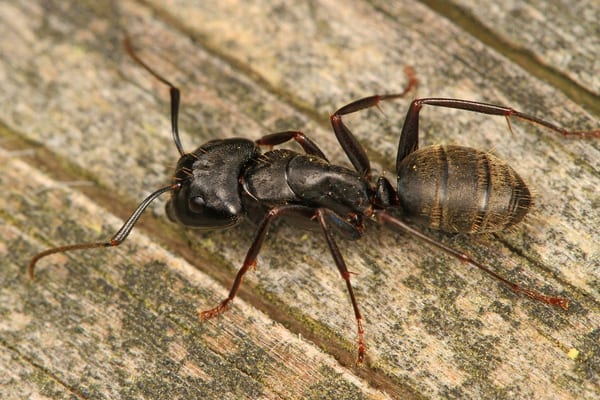
How to recognize carpenter ants
- Large black ants with a narrow, pinched waist and elbowed (bent) antennae.
- Winged carpenter ants keep their wings for a while after swarming, and their back wings are shorter than their front wings. Winged termites shed their wings quickly, and all four of their wings are the same length.
Signs you have them
- Ants inside in winter. MSU calls this a very strong indication of a nest in the building.
- Little piles of wood shavings, like pencil-sharpener shavings, below small openings in wood, sometimes mixed with bits of insects.
- Damp or decayed wood around leaks, sinks, bathroom tile, windows or places with poor airflow.
Carpenter ant galleries are clean and smooth inside. Termite galleries have soil in them, which is one of the easiest ways to tell the damage apart.
When they show up in Michigan
Spring is when most people notice them. They wander in looking for water and food, and a spring sighting on its own doesn’t prove there’s a nest in the house. Winged ants indoors in summer don’t prove it either. Winter is different: active carpenter ants inside in January almost always means they’re living indoors.
Are they harmful?
They damage wood over time as they enlarge their nests. They also point to a moisture problem, which needs fixing whatever happens to the ants.
What you can do yourself
- Find and fix the moisture: leaks, condensation, wood touching wet soil. MSU’s advice is that an indoor nest has to be found and dealt with, and the wet wood corrected.
- Read the label before using any product indoors. Some aren’t labeled for use inside homes, and the label is the law.
- Not sure what you’ve got? MSU’s Plant & Pest Diagnostics lab can identify a specimen for a fee.
When to call us
Call or text if you’re seeing carpenter ants inside in winter, finding piles of shavings, or can’t find where they’re nesting.
Related pests
- Termites: the pest carpenter ants are most often mistaken for.
- Ants: the smaller ants that trail into kitchens.
- Home pest control: how we handle ants and other insects.
Common questions
Carpenter ants or termites: how can I tell?
Look at the waist and the wings. Carpenter ants have a pinched waist, bent antennae and back wings shorter than the front ones. Termites have a thick waist, straight antennae and four equal wings they shed quickly. Inside damaged wood, carpenter ant galleries are clean; termite galleries have soil.
Why am I seeing big black ants inside in winter?
Because they’re probably living inside. Carpenter ants outdoors are inactive in a Michigan winter, so ones walking around your kitchen in January are most likely coming from a nest in the walls, floors or another damp spot in the house.
Do carpenter ants eat wood?
No. They chew tunnels in wood to nest in and push the shavings out, but they don’t eat it. Termites are the ones that eat wood.
Sources
- MSU Extension: Carpenter ants, the other unofficial state insect of Michigan
- MSU Plant & Pest Diagnostics: Winged carpenter ants
- MSU Extension: Carpenter ants nesting in trees and homes
- Ohio State University Extension: Carpenter ants
- University of Minnesota Extension: Ants
- University of Minnesota Extension: Carpenter ants
Seeing carpenter ants?
Call or text, or send the form, and we’ll take a look.
Photo at the top: Judy Gallagher, CC BY 2.0
