
Fall invaders
Crickets in Lansing homes
The crickets that end up in Michigan basements are usually camel crickets (humpbacked, wingless, drawn to cool, damp places) or field crickets that wandered in from outside by mistake. They rarely breed indoors and are mostly a nuisance, though field and house crickets can chew fabrics if there are a lot of them. Drying damp areas, sealing gaps and sweeping up the strays handles most cases, and field cricket problems end when a heavy frost kills the adults.
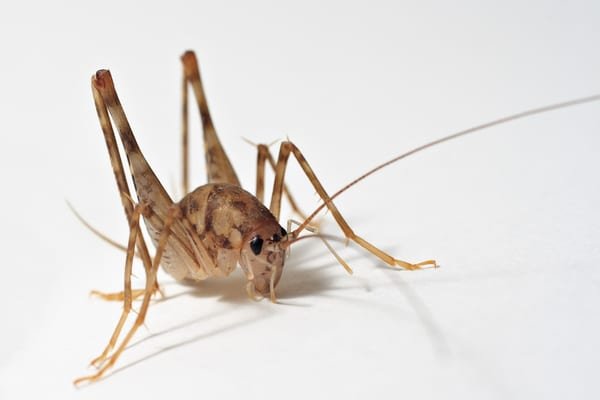
How to recognize crickets
- Camel (cave) crickets: brownish and humpbacked, no wings, very large hind legs with “drumstick-shaped” thighs and long, slender antennae. Up to an inch long (Iowa State); Minnesota gives about ¾ inch.
- Field crickets: dark brown to black, ½ to ¾ inch, with rounded wings that almost cover the body (Minnesota).
- House crickets: light yellowish-brown with three dark bands behind the head and long, pointed wings, about ¾ inch (Minnesota).
Signs you have them
- Jumping crickets in basements, garages and crawlspaces.
- Camel crickets indoors are usually “accidental invaders” that wandered in from nearby (Iowa State). Field crickets live outdoors and come in by mistake for only part of their life cycle (Iowa State).
When they show up in Michigan
Field crickets wander indoors in late summer and fall; the problem ends when heavy frost or a freeze kills the adults (Iowa State). Illinois Extension lists crickets among the fall insects that come inside and says the traffic subsides once colder weather arrives. Crickets have one generation a year in Minnesota (Minnesota).
Are they harmful?
- Property: no major damage; usually just a nuisance (Minnesota). Field crickets do no significant damage outdoors, “only lost sleep” (Iowa State).
- Fabrics: indoors, field crickets can feed on cotton, linen, silk and wool, and house crickets on silk and wool, with severe damage possible when they’re numerous. Camel crickets rarely feed on fabrics (Minnesota).
- Breeding indoors: rare (Minnesota). Camel crickets only reproduce indoors where it stays continuously dark and moist (Iowa State).
What you can do yourself
- Dry damp areas with a fan or dehumidifier, especially for camel crickets, which prefer moisture (Minnesota).
- Seal the way in: cracks and gaps in the foundation and siding, around windows and doors, and screens (Iowa State); openings around pipes, wires and chimneys, tight-fitting windows and doors, and window screens without holes (Illinois).
- Clear hiding spots next to the house: piles of bricks, stones, boards and leaves, and vegetation and debris against the foundation (Iowa State).
- Sticky traps: camel crickets are especially attracted to them (Minnesota).
- Pick up the strays: sweep or pick them up (Iowa State), or vacuum them and empty them into soapy water (Illinois).
- Skip indoor sprays: indoor insecticides are generally not recommended (Illinois); indoor residual treatments give little if any benefit, and lawn and garden concentrates should never be used indoors (Iowa State).
- Perimeter sprays along the foundation: Iowa State describes them as a barrier against migrating crickets; Illinois says exterior insecticides are often ineffective because the insects are so mobile. To work at all, barrier sprays have to go down before the insects start coming in, roughly September to mid-October (Iowa State, fall invaders article). Follow the label.
When to call us
Rarely needed.
Related pests
- Earwigs: another damp-area insect that wanders in.
- Millipedes: damp-soil wanderers, often after rain.
- Home pest control
Common questions
What are the jumping crickets in my basement?
Usually camel crickets: brownish, humpbacked and wingless, with very large hind legs and long antennae. They’re drawn to cool, damp places and, according to Iowa State Extension, usually wander in by accident from nearby.
Can crickets damage clothes or anything else in the house?
Mostly they’re a nuisance. But Minnesota Extension says field crickets can feed on cotton, linen, silk and wool indoors, and house crickets on silk and wool, with severe damage possible when they’re numerous. Camel crickets rarely feed on fabrics.
Why are crickets coming inside in the fall?
Field crickets live outdoors and wander in by mistake in late summer and fall. Iowa State Extension says the problem ends when a heavy frost or freeze kills the adults.
Will crickets breed in my house?
Rarely. Camel crickets only reproduce indoors where it stays continuously dark and moist, so drying damp areas with a fan or dehumidifier helps.
Sources
- University of Minnesota Extension: Crickets
- Iowa State University Yard and Garden: Camel cricket
- Iowa State University Yard and Garden: Cave crickets
- Iowa State University Yard and Garden: Field cricket
- Iowa State University Yard and Garden: Fall nuisance invaders
- University of Illinois Extension: Fall house guests
- University of Illinois Extension: Insects inside the home this fall
Crickets in the basement?
Call or text, or send the form, and we’ll take a look.
Photo at the top: Thegreenj, CC BY-SA 3.0
